
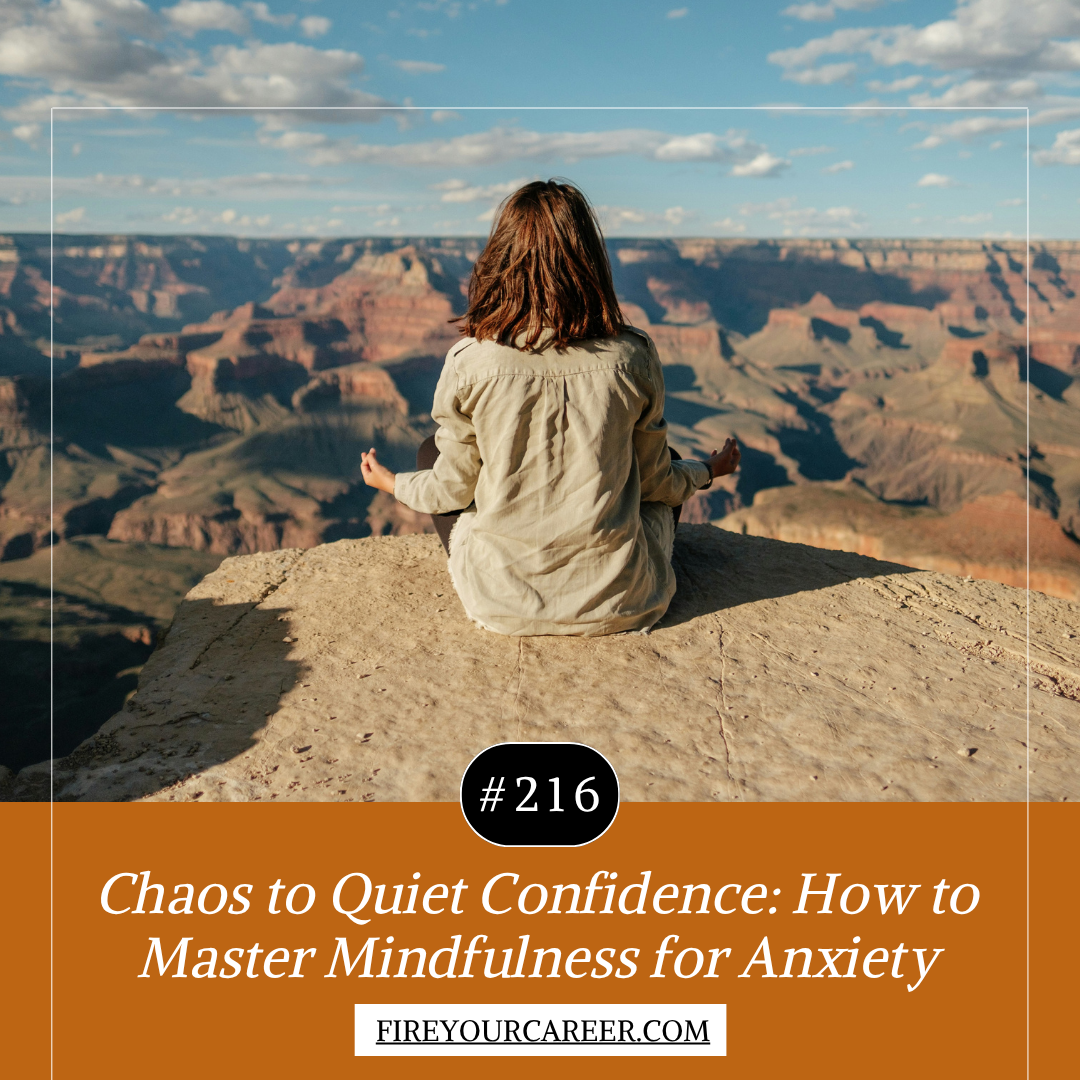
#216: Chaos to Quiet Confidence: How to Master Mindfulness for Anxiety –
Full disclosure: I am a proud affiliate, meaning if you click a link and make a purchase, I may earn a commission at no extra cost to you. My recommendations are based on deep experience with and knowledge of the products I mention and I recommend products only when they are genuinely helpful and useful, not because of the small commissions I may receive. Please don’t spend any money on products I recommend unless you genuinely believe they will help you achieve your goals.
How do you cultivate mindfulness for anxiety?
Our society glorifies hustle culture. We’re constantly plugged in, our phones ping constantly with notifications, and we’re pressured to achieve more, faster.
The nonstop buzz can create an underlying hum of chaos, one that easily vibrates into a tone of anxiety.
It’s easy to feel anxious when you’re constantly on the go. It can be difficult to calm the chaos and relax.
Anxiety isn’t just unpleasant; it steals your time, focus, and happiness. It can paralyze your decision-making when you most need it.
However, there is a way to turn the volume down on chaos. You can replace it with a centered, steady sense of quiet confidence.
The answer isn’t fighting the chaos; it’s changing your relationship with it. A good self-care routine can help you unwind and address your mindfulness needs. Maybe you prefer a mix of meditation, a warm bath, or a good book.
In any case, you’ll learn a series of habits and practices you can implement to master mindfulness for anxiety.

Why Mindfulness for Anxiety is the Modern Professional’s Essential Skill
Anxiety is often described as “living in the future.” It’s the mental tax for worrying about a Q4 projection that hasn’t happened yet or a career pivot you’re afraid to make.
Mindfulness tethers you in the present moment.
It’s not about simply relaxing. When you incorporate mindfulness for anxiety, you clear the cache of your mental hardware. You reclaim the cognitive bandwidth required to solve complex problems and lead with clarity.
Mindfulness for Anxiety and Your Path to Career Freedom
You might be wondering: what does mindfulness have to do with my practical goals of building a career I love and achieving financial independence? The connection is profound.
A calmer, less anxious mind is also a clearer, more resilient, and more strategic mind. Mindfulness for anxiety allows you to:
- Make Better Decisions: When you aren’t reactive to anxiety, you can make career and financial choices based on strategy and values rather than fear or a desire for immediate escape.
- Enhance Focus and Productivity: A mindful approach to work means fewer mental distractions, leading to deeper focus and better outcomes.
- Boost Creative Problem-Solving: A quiet mind can think beyond immediate stressors, opening up more creative and innovative solutions to challenges on your path.
- Improve Relationships: By being more present, you can connect more authentically, network more effectively, and navigate potentially stressful interactions with greater ease.
- Enjoy the Journey: Mastering anxiety allows you to appreciate your current progress, find joy in your work, and truly live your life along the way to your long-term goals.

The Foundation of Quiet Confidence
It’s easy to mistake confidence for extroversion or booming certainty. Quiet confidence, however, is deeper. It’s the internal steadying that comes when you trust yourself to handle whatever the present moment holds.
This is exactly what mindfulness for anxiety provides.
Mindfulness is the practice of paying attention to the present with openness and curiosity, without judgment. When you apply it to anxiety, you stop processing anxious thoughts. Instead, you acknowledge them without giving them control.
It shifts you from being the storm to observing the storm from a place of safety. This gives you back control of your destiny.
A Crucial Shift in Perspective: Decoding Mindfulness for Anxiety
When you’re career-focused, you often use analysis and problem-solving to overcome challenges. However, you cannot “think” your way out of anxiety, because anxiety is overthinking.
The strategies that got you to where you are today aren’t always the ones that will take you to the next level. To master anxiety, you must move from analysis to awareness.
Instead of asking, “Why am I anxious? How do I fix this thought?” (which triggers more thinking), mindfulness helps you understand the physical sensation.
“What does this anxiety feel like in my body right now?” Perhaps it’s a tight chest, shallow breathing, or tension in the jaw. By focusing on the direct physical experience, you anchor yourself in the now rather than drifting into hypothetical futures.

Practical Steps Toward Quieting the Mind
Knowing the theory of mindfulness is helpful; practicing it is where your transformation begins. You don’t need twenty minutes of daily meditation either. You can build quiet confidence in the micro-moments of your day.
Don’t be afraid to experiment and figure out what approach works best for you. What works well for someone else may not be the best fit for you, and that’s ok. What matters is that you incorporate the strategies that support your needs.
Here are a few approaches to try:
1. The “Box Breathing” Technique
Physiology influences psychology. Anxiety and shallow breathing reinforce one another. Box breathing breaks this loop.
Inhale slowly for four counts, hold for four, exhale slowly for four, and hold the empty lung for four. Repeat this for two minutes.
This simple act tells your nervous system that you are safe, providing immediate support when you’re overwhelmed.
2. The “Observer” Label
Next time you worry about something specific (e.g., “What if I never reach my FIRE number?”), don’t fight it. Label it.
Say to yourself, “I’m worried about financial insecurity.” This simple shift in language creates the distance necessary for mindfulness to take root.

3. Radical Acceptance
When an anxious thought arises, try saying to yourself: “This is anxiety. I’m noticing it. It’s uncomfortable, but I can tolerate this feeling.” It might sound ridiculous at first, but it often helps.
This is one way you can acknowledge your feelings without getting lost in them. Acknowledging a feeling is the first step toward disempowering it. You are accepting the presence of the feeling, not the narrative the feeling is trying to sell you.
4. Sensory Anchor Points
Your senses are always in the present moment. Anxious thoughts pull you into the future or the past.
When you feel chaos building, pause and name: 5 things you can see, 4 things you can physically feel (e.g., the seat beneath you), 3 things you can hear, 2 things you can smell, and 1 thing you can taste (or one physical sensation you appreciate).
This practice will help you quickly and effectively ground yourself in the present moment.

5. The Body Scan: Grounding Yourself Physically
Anxiety often has strong physical components like a racing heart, tense muscles, or shallow breathing.
A body scan practice involves systematically bringing awareness to different parts of your body, from your toes up to your head, without trying to change anything, just observing.
Notice tension? Acknowledge it, perhaps send a gentle thought of relaxation there, but the primary goal is simply to notice and be present with your body. You might also tense up the part of your body you’re focusing on, releasing it as you move on to the next focus area.
Similar to building a healthy daily routine, incorporating even a 5-minute body scan into your morning or evening can cultivate a greater awareness of and control over physical stress responses.
Integrating Mindfulness into Your Career Journey
As you master mindfulness for anxiety, watch how it ripples out into your life, personally, professionally, and beyond. The impact may amaze you.
When you’re no longer consumed by internal chatter, you become a better listener, a more creative problem-solver, and a steady presence in high-pressure situations. You learn to lead from a place of authenticity rather than reactivity.
This shift from chaos to quiet confidence is an essential component of learning to FIRE Your Career, allowing your professional life to work for you, so that you can thrive, rather than simply survive.
Will you calm the chaos to build a life on your terms?

Finding Support on the Path
Quiet, calm confidence is built incrementally. Be gentle with yourself as you explore these practices. You don’t have to do it alone.
Take Your Next Step Toward Freedom
If you’re ready to build a life on your terms…
The journey to financial freedom isn’t simple, but it is rewarding. If you’re ready to stop trading your life for a paycheck and start living life on your terms, I’m here to arm you with tools that drive your success.
- Professional Mentoring: Get a tailored roadmap to speed up your journey to financial freedom. You’ll also gain an upper edge in your career, finance, and lifestyle goals. With my mentoring program, you’ll get a personalized strategy to build a life on your terms, so that you can spend more time doing what you love.
- Book a call to learn more about my mentoring program.
- Download the Free Ebook: Turn your goals into action with my free ebook “7 Ways to FIRE Your Career.” It’s a powerful guide to ignite your journey toward financial independence, whether you’re more focused on your career goals, finances, or lifestyle plans.
- Get the free ebook to begin building your path to financial freedom.
Together, we can help you gain total control of your finances so you can begin living life on your terms. You’ll spend less time in the “grind” and more time doing what you love with the people who matter most.
Have a question or want to learn more? Leave a comment below!
Now that you’ve learned how to master mindfulness for anxiety, you might wonder how else you can FIRE Your Career. Check out the posts page for more ways to FIRE Your Career and achieve financial freedom.
FIRE Your Career: Achieve Financial Freedom Through Your Career & Spend MORE Time Doing What You Love.

Resources I Recommend in This Article:
The FIRE Your Career Mentoring Program (a personalized approach to help you gain control of your career and finances)
7 Ways to FIRE Your Career (a free ebook to help you build a foundation for financial freedom)
Resources I Frequently Recommend:
Udemy (a learning platform with courses to help you acquire new skills)
Quit Like a Millionaire (a great FIRE book with a scoring system to help you select a degree or job field)
ClickUp (my recommended goal-tracking and project-management tool)
The Bogleheads’ Guide to Investing (a great intro to investing book)
Strengths Finder (book to help you uncover your innate strengths, includes a free personality quiz)
Other Recommended Reading:
#142: Work Less, Live More: How to Cultivate a Mindset for Financial Freedom
#213: How to Manage a Toxic Boss

#198: The Secret Weapon: How to Power Your Success with a Mentor Program
#110: How to Develop a Winning Money Mindset to Drive Your Financial Freedom Journey
#171: Growth Mindset: a Career You Love and Financial Freedom
#153: How to Build a Growth Mindset for Success
#178: How to Build Long-Term Sustainable Wealth
#146: 10 Ways Financial Independence Leads to a Happier Life
Strengths Finder: Identify Your Career Strengths
How to Find Your Why So You Can FIRE Your Career
How to Use the FIRE Method to Build a Life on Your Terms
Goal Planning for 2026 and Beyond: Prepare Your Epic Year
