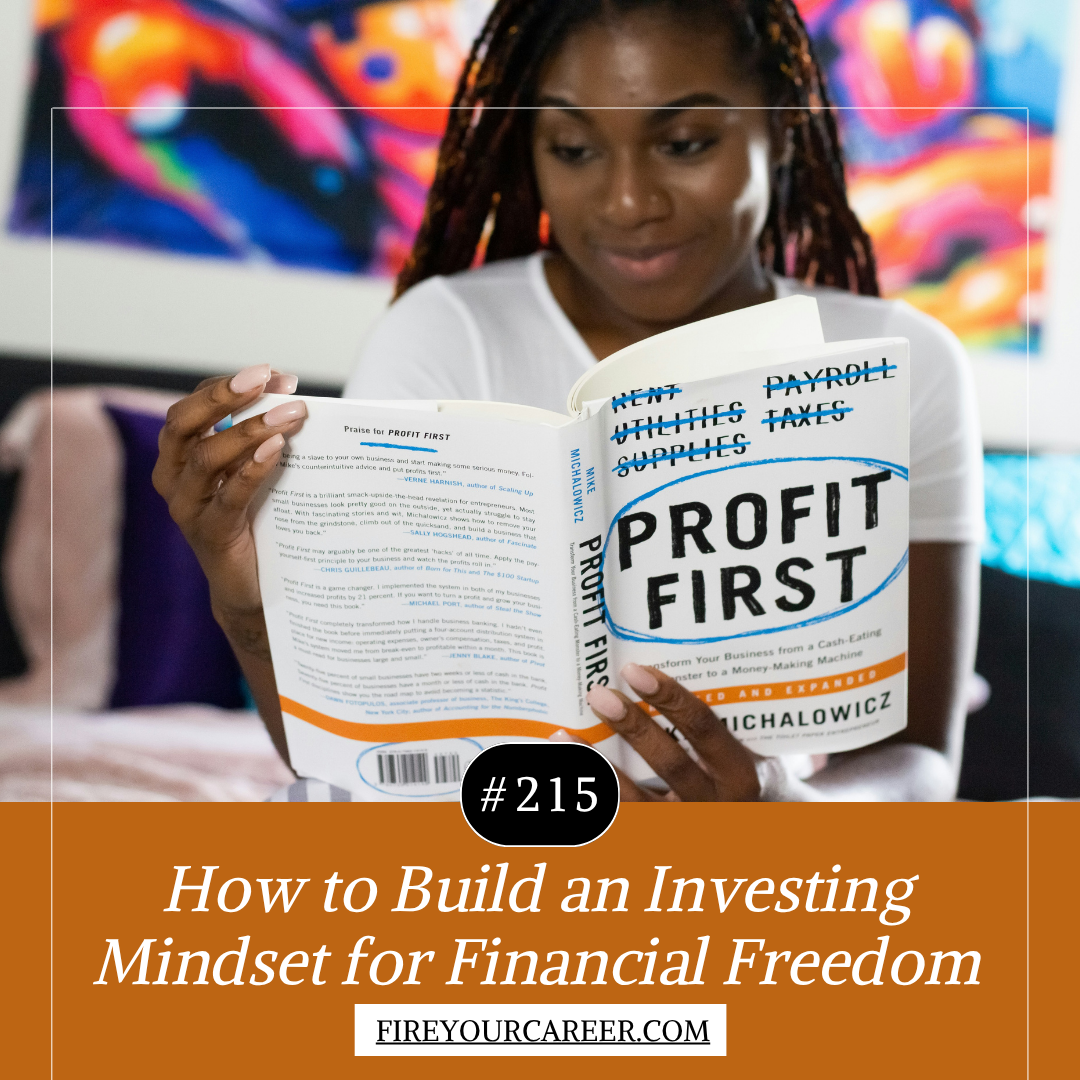
#215: How to Build an Investing Mindset for Financial Freedom

#215: How to Build an Investing Mindset for Financial Freedom –

An “investing mindset” prepares you for long-term financial freedom. To truly achieve life on your terms, you must cultivate a mindset that works for you, and that includes investing. Here’s why:

For one, an investing mindset is about recognizing that every dollar is a “seed” intended to grow into a “tree” of passive income, providing you with the shade of security for years to come.

Secondly, it’s easy to focus on the numbers, because let’s face it, investing is a numbers game. However, there’s a lot of psychology that happens behind the investing scenes, whether or not you’re aware of it.

It’s about perception…

The stock market alone is valued based on the perception of value. Read that again. Some of that actual value is based on reality, while the rest reflects investors’ perceived potential.

Confused yet? We’ll break it down soon, but let’s get back to what it means to have an investing mindset.

And your mindset…

To develop an investing mindset, you’ll need to understand your own psychology, but you’ll want to understand the psychology of other investors, too. If you follow stories like “Wall Street Bets” (look it up if you aren’t familiar), you know that even a motivated group can sway a stock price.

What does that mean for your investments? The stock market is like the ocean tide – it rises, it falls. Those falls can be scary, and if you intend to invest in stocks, you’ll need to learn to stomach them.

You don’t want to sell a large portion of your investments in a down market, because then you’ll realize a loss. You’ll also want to be strategic about when you buy (within reason), so that you don’t always buy at the top or consistently sell at the bottom.

This is where your investing mindset can be your strategic advantage. You’ll learn to make strategic investments without emotion, enabling you to be practical and tactical.

In this article, you’ll learn everything you need to build an investing mindset that helps secure your financial freedom.
Read More

#187 How to Make SMART Investing Choices in a Spooky Market

#187: How to Make SMART Investing Choices in a Spooky Market –

In a spooky market, it can be harder than ever to make smart investing choices.

The air is getting crisp, the leaves are turning, and there’s a certain chill that signals the familiar arrival of fall. This year, however, it feels like there’s more than just a seasonal shift. The market feels more uncertain than ever.

A spooky market, much like a haunted house, is full of surprises. One moment, the market is soaring, only to have the floor drop out from under you the next. This unpredictability can make even the most seasoned investors feel like a witch is chasing them on a broomstick. 

In times like these, it’s easy to feel like you’re wandering through a dark and mysterious graveyard, unsure of your next step. 

SMART Investing, Spooky Time and Beyond

Whispers of a looming recession and the fear of market goblins and ghosts have many investors paralyzed with uncertainty. It’s easy to get spooked when the financial news is filled with dire predictions and frightening headlines.

In a world where market witches cackle about future downturns, it’s virtually impossible to predict what will happen next. Trying to time the market is a game you can’t win. Instead of listening to every scary rumor, focus on what you can control.

The key to navigating a spooky market isn’t a crystal ball or a witch’s brew; it’s a thoughtful, proactive approach to your finances. Rather than hiding under your bed, this can be an empowering time to take control of your financial future.

Don’t let ghostly predictions dictate your decisions. Instead, let’s talk about smart investing with a simple, powerful framework: SMART investing goals.

SMART goals are one of the most powerful tools in your arsenal, and in this article, you’ll learn everything you need to know to make SMART investing choices that are ideal for you and your personal circumstances.

Read More